
How to Avoid the Top Office Fit Out Mistakes Bengaluru Projects Face
The sun-baked concrete stretches along Bengaluru’s Outer Ring Road hold a quiet warning. Empty shells of half-finished spaces stand as silent monuments to grand designs that ran completely out of money before a single chair arrived. Teams arriving in Karnataka often expect a straightforward setup but quickly run into a wall of local red tape, erratic supplier schedules, and soaring resource costs.
We see these exact office fit out mistakes Bengaluru builders repeat year after year. Let us look closely at how these projects fall apart so you can shield your hard-earned funds from the same fate.
Smart planning and a few sharp office renovation budget tips Bangalore teams swear by can save you from these draining delays. You can drastically lower the overall office setup cost Bengaluru projects usually rack up.
Let me share how we stepped in to save a twenty-thousand-square-foot site in Whitefield from turning into a costly disaster. Turning raw, dusty concrete into a lively workspace is a journey riddled with unseen traps that demand local knowledge.
Spotting these hurdles early is how you build a space that energizes your people without emptying your bank account. Every choice you make in those first few days ripples outward, heavily affecting your final move-in date and your total spend.
Mistake 1: Getting Tangled in Local Municipal and Utility Approvals
A fast-growing software startup leased a beautiful, bare floor inside a prized tech park in Bellandur. The founders assumed they could throw up some drywall, slap on some paint, and move their team of a hundred engineers in within six weeks. They completely forgot about the complex web of permits required by the Bruhat Bengaluru Mahanagara Palike (BBMP) and the Bangalore Electricity Supply Company (BESCOM).
Their work ground to a sudden halt by week three because they lacked a formal Occupancy Certificate (OC) and an approved electricity upgrade. The city inspectors halted everything when they saw the cooling layout altered the original safety plan of the building. The startup spent the next two months paying hefty rent on an empty, silent room while waiting for paper clearances.
To keep your project moving, check the power limits of the building before signing any lease. Commercial properties here usually need at least ten to twelve kilowatts per thousand square feet of usable space. If your business needs more juice, expect to wait around ninety days for the power utility to review and clear your upgrade request.
Mistake 2: Wandering Into the Gridlock of Local Traffic
We once watched over a project where high-end sound-absorbing panels from Europe landed at the Chennai port right on time. The cargo went onto a container truck headed for Indiranagar, a trip that normally takes nine hours. The driver hit the Outer Ring Road during peak hours and spent twelve grueling hours traveling just six kilometers.
The legendary traffic congestion in this city is a physical force you must plan around with absolute care. Local police restrict heavy trucks from entering major business zones during daylight hours to keep roads clear. This means your bulky materials, from massive drywall sheets to fragile glass panels, must arrive between ten at night and six in the morning.
If you do not schedule night crews to unload these trucks, you will face steep delay fees and missed deadlines. Keep lines of communication open with building security and property managers to ensure the cargo elevators are unlocked at midnight. Giving your deliveries a three-day safety margin keeps a single traffic jam from ruining your entire building schedule.
Mistake 3: The Trap of Heavy, Permanent Customization
An investment firm in Koramangala wanted their workspace to have a raw, industrial feel with solid brick walls. They poured nearly half of their funds into heavy, unmovable structures to create cozy meeting rooms. Two years later, their team size doubled and they desperately needed an open, shared floor plan.
Tearing down those solid brick walls kicked up clouds of thick dust that threatened their sensitive servers. It forced them to rent temporary shared desks elsewhere just to keep working. To make matters worse, the landlord pointed to the lease clause requiring them to return the bare shell exactly as they found it.
The firm ended up paying twice—once to build the heavy walls, and again to destroy them.
Wise builders choose flexible, movable partition systems that can be shifted over a weekend. These smart setups protect your initial cash because you can pack them up and take them with you if you move. This adaptability is the best way to handle real estate changes in fast-growing tech areas.
Comparing Area Costs Across the City
To sketch out an accurate budget, you must understand how building costs shift across different areas of the city. The table below shows the typical cost ranges and timeframes across key tech zones based on recent build data.
| Area in Bengaluru | Typical Cost Range (INR per Sq Ft) | Usual Timeframe (Weeks) | Main Delivery Challenge |
|---|---|---|---|
| Outer Ring Road (ORR) | 2,800 to 4,200 | 10 to 12 | Heavy truck bans during daylight hours. |
| Whitefield | 2,500 to 3,800 | 12 to 14 | Unpredictable city water line hookups. |
| Indiranagar and Central Area | 3,500 to 5,500 | 8 to 10 | Very tight parking and loading zones. |
| Electronic City | 2,200 to 3,200 | 12 to 16 | Longer shipping times for specialized goods. |
These numbers show why local planning matters when setting your initial budget. Picking a spot in Indiranagar might give you a prestigious address, but it drives up transportation costs due to tight streets. Whitefield offers larger floors but requires careful handling of water lines and local utilities.
Mistake 4: Skimping on Cooling and Air Flow
Many design firms draw up office layouts based on general weather data that does not fit the dense tech parks here. The city is famous for its cool breeze, but the heat built up inside a modern office is massive. Hundreds of laptops, monitors, servers, and warm bodies create a major cooling challenge.
We helped a software group in Electronic City where workers complained of sluggishness and headaches by mid-afternoon. Our check showed their cooling system was set up for one person per hundred square feet. The company had packed their engineers in at twice that density to save space.
The lack of fresh air made carbon dioxide levels climb to dangerous levels. Fixing this meant installing extra fresh air units, which cost twice as much to add later as it would have at the start. Always ask for a detailed heat load study that accounts for your actual team size and hardware.
Mistake 5: Falling for the Cheapest Bidder
A web retailer decided to hire a builder from another state who offered a price twenty percent lower than local options. This choice backfired when the builder struggled to find skilled workers nearby. They did not understand local labor habits, which led to arguments, walkouts, and messy work.
The project slipped by four months, forcing the company to pay double rent on both their old temporary lease and the new empty space. Local builders have trusted networks of carpenters, electricians, and plumbers who know the local building codes. These relationships keep things moving when supply chains break down.
When you compare bids, look beyond the final number and check the builder’s local history. Ask to speak with past clients who completed similar builds nearby over the last year. Walking through a live site they currently run tells you far more than a glossy presentation.
Mistake 6: Ignoring Sound and Noise Control
The trend of open offices has led many teams to get rid of private rooms altogether. A marketing firm in HSR Layout built a beautiful open space with bare concrete floors and glass walls. The office looked stunning in photos but was a nightmare to work in.
The hard concrete and glass bounced sound everywhere, creating a loud echo that made calls impossible. Workers had to whisper to keep their conversations private. This lack of quiet drove down focus and forced many to work from home.
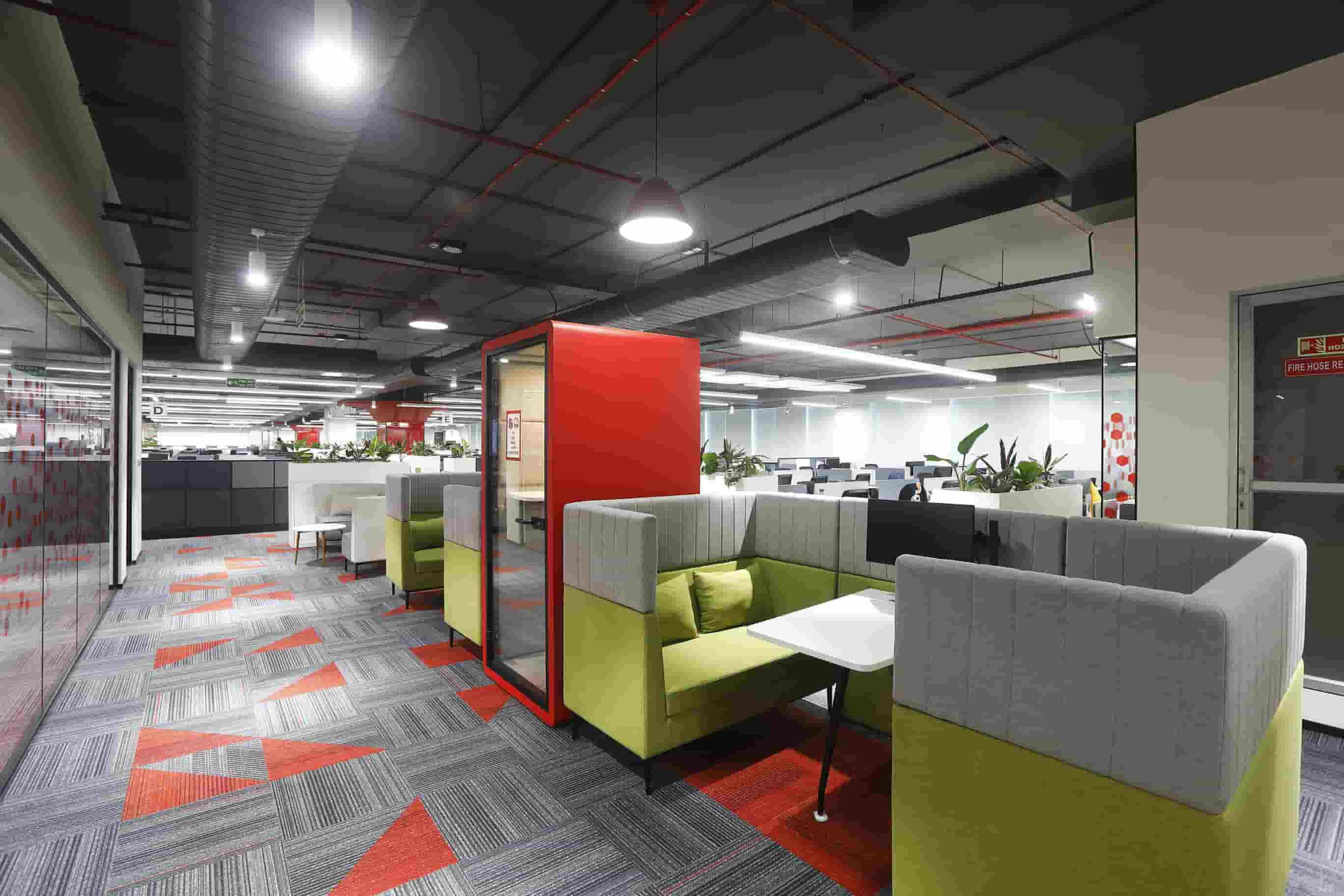
Fixing this noise issue required adding specialized sound panels, carpet tiles, and small phone booths. Plan for sound from day one by picking thick glass partitions with high sound ratings. Use soft fabrics, rugs, and acoustic tiles to soak up noise in busy areas.
Mistake 7: Leaving the Tech Setup for the Last Minute
We often see builders spend all their energy on cool desks and lights, leaving the internet cables for the final week. A financial firm built a stunning space in Yeshwanthpur but forgot to map out their network lines. They realized too late that the floor channels were too small to hold the hundreds of cables needed for their desks.
This forced them to run ugly plastic covers along the fresh walls, ruining the clean look of the space. Their server room was squeezed into a tiny, hot closet with no cooling, causing constant internet crashes. Fixing this afterward cost three times what it would have during the initial build.
Your network layout must be part of the very first floor plans. Make sure your server room has its own cooling unit that runs even when the main office system is off. Plan for backup internet lines coming into the building to keep you online during road repairs outside.
Simple Rules to Guard Your Budget
To keep your build on track, use these three simple steps right from the start.
- Work with a local guide who knows how to handle the local utility and city approvals.
- Keep a safety fund of fifteen to twenty percent to cover unexpected transport and permit fees.
- Choose modular, moving parts over permanent walls to make future changes easy.
Steering clear of these common office fit out mistakes Bengaluru projects face takes a mix of clear design, local knowledge, and tight spending. Focus on getting your permits early, planning deliveries around nighttime traffic, and using flexible layouts. Keep your team comfortable by focusing on good air flow, quiet zones, and solid internet setups.
By working with experienced local hands and using these steps, you can create a wonderful workplace on time and within your budget.