
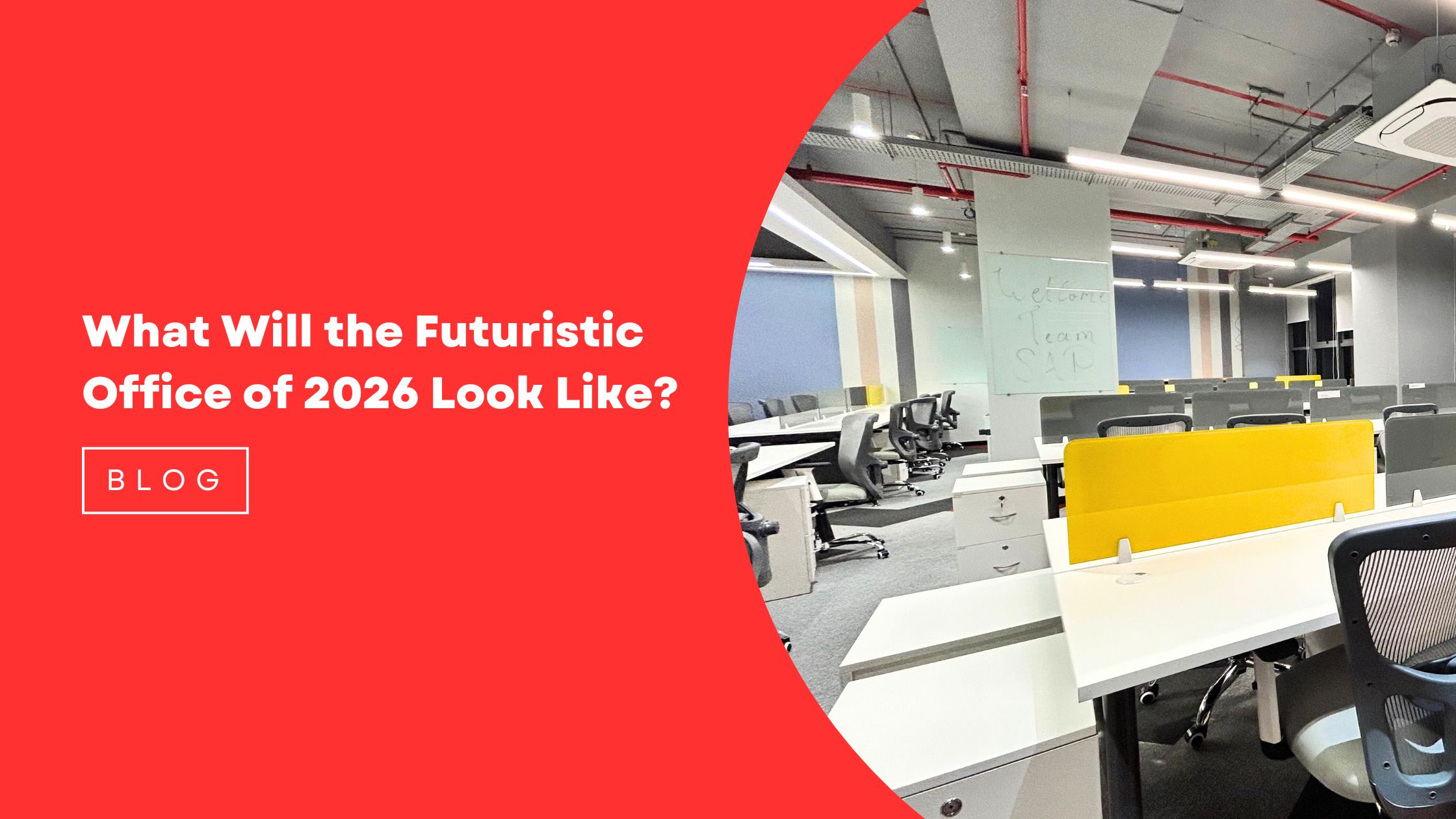
Is Your Office Layout Ready for 2026?
In the rapidly evolving landscape of workplace culture, office interior designers are redefining what a “modern office” truly means. As we look toward 2026, the era of the office as a mere container for desks is long gone. But interestingly, the era of the office as a playground—filled with slides, neon lights, and chaotic open plans—is also fading.
The futuristic office of 2026 is defined by two pragmatic pillars: support for hybrid work and ease of maintenance.
For business leaders and facility managers, the goal is no longer just to impress with visual spectacle, but to impress with operational efficiency. A truly futuristic interior is not about flashy ceilings or sci-fi aesthetics; it is about structured planning, intelligent zoning, and a layout that works as hard as your team does.
Here is how structured planning is redefining the workspace for the hybrid era.
The Death of “Flashy” and the Rise of “Functional”
For years, companies conflated “futuristic” with “expensive decoration.” We saw complex ceiling baffles that gathered dust, intricate flooring that was impossible to clean, and open layouts that looked great in photos but sounded like a cafeteria in practice.
By 2026, the aesthetic has matured. The new futuristic office is understated. It prioritizes:
- Durability: Materials that withstand the high turnover of hot-desking.
- Maintainability: Surfaces and layouts that are easy to clean and repair without shutting down operations.
- Clarity: Designs that guide behavior without needing signage.
This shift is driven by the hybrid model. When employees come into the office only two or three days a week, they aren’t coming in to sit in a cubicle and answer emails—they can do that at home. They are coming in to collaborate, to connect with the brand, and to feel part of a culture. If the office is cluttered, confusing, or poorly maintained, it fails that primary objective.
1. Clear Zoning and Movement: The Backbone of Efficiency
The most critical element of the 2026 office is flow. A well-planned office functions like a well-planned city; it has distinct zones for different activities, and the movement between them is intuitive.
When we talk about “Clear Zoning,” we are referring to the logical placement of the reception, waiting lounge, director’s cabin, workstations, conference rooms, and breakout areas. These shouldn’t be scattered randomly; they must have a narrative arc.
The “First Impression” Zone: Reception and Lounge
In a hybrid world, clients and partners visit the office more intentionally. The reception area is no longer just a waiting room; it is a physical manifestation of your brand identity.
- The 2026 Approach: Layouts that give visitors an immediate, strong sense of the brand the moment they step off the elevator.
- The Design Logic: This area needs to be distinct from the deep-work zones. It should be welcoming but acoustically separated so that the buzz of the lobby doesn’t bleed into the workstations.
The “Deep Work” vs. “Collaboration” Split
One of the biggest failures of the open-plan era was mixing loud collaboration with quiet focus. Structured planning solves this by zoning areas based on noise levels.
- Director Cabins & Private Offices: These are strategically placed to offer privacy without isolation. Glass partitions (more on that below) allow leaders to remain visible and accessible while maintaining acoustic confidentiality.
- Workstations: Clustered in areas with the best natural light, away from high-traffic corridors to minimize distraction.
2. Privacy in the Age of Transparency
There is a misconception that “structured” means “walled off.” However, the 2026 office balances the need for privacy with the desire for openness.
Glass Partitions and Acoustic Panels The modern office relies heavily on glass partitions. They allow light to penetrate deep into the floor plate, making the office feel larger and more vibrant. However, glass reflects sound, which can be a disaster for hybrid meetings.
The solution lies in the integration of acoustic panels. In 2026, we don’t just stick foam on the wall as an afterthought. Acoustic treatments are integrated into the design language—embedded in lighting, disguised as art, or built into the furniture itself.
- Why it matters: In a hybrid meeting, half the team is on a screen. If the room has an echo, the remote participants can’t hear clearly. Structured acoustic planning is arguably the most “high-tech” feature of a modern office, ensuring that digital and physical collaboration is seamless.
3. Circulation: The Art of Decluttering
Nothing kills productivity faster than visual and physical clutter. A key tenet of the text provided is keeping circulation passages free from “cupboards and random storage.”
In the past, storage was often an afterthought—bulky filing cabinets placed in hallways or boxes stacked in corners. This not only looks unprofessional but impedes movement and creates a fire hazard.
The “Hidden Storage” Philosophy Futuristic planning integrates storage into the architecture.
- Flush Walls: Storage walls that look like paneling but open up to reveal ample shelving.
- Digital First: As 2026 embraces a near-paperless workflow, the need for massive physical storage shrinks, allowing designers to reclaim that square footage for breakout areas or collaborative lounges.
By keeping passages clear, you improve the energy flow of the office. Employees can move from a desk to a meeting room without navigating an obstacle course. This subtle ease of movement reduces low-level stress and improves the overall employee experience.
4. Future-Proofing: Expansion Without Destruction
Perhaps the most visionary aspect of the 2026 office trend is the focus on modularity. The prompt highlights a crucial requirement: “allow future expansion without reconstructing the entire office.”
Business moves fast. A team of 20 today might be a team of 50 next year. Or, a department might switch from 100% in-person to 100% remote.
The Modular Layout
- Flexible Grids: Power and data are run through grid systems (often under raised floors or in accessible ceiling trays) that allow desks to be reconfigured without rewiring the building.
- Movable Walls: Instead of drywall, companies are opting for demountable architectural walls. If you need to turn one large conference room into two smaller breakout rooms, it can be done over a weekend with minimal waste and cost.
This approach transforms the office from a “sunk cost” into a flexible asset. It acknowledges that the only constant is change, and builds a structure that can adapt to it.
Structure is the New Luxury
As we move toward 2026, the “wow factor” of an office won’t come from how much money was spent on the chandelier. It will come from how effortlessly the space functions.
A futuristic office is one where a hybrid video call connects instantly without echo; where a visitor walks in and immediately understands the brand’s values; where an employee can find a quiet corner to think or a lively table to brainstorm without friction.
By focusing on clear zoning, logical movement, acoustic privacy, and clutter-free circulation, companies can build workspaces that are easy to maintain, delightful to use, and ready for whatever the future holds.