
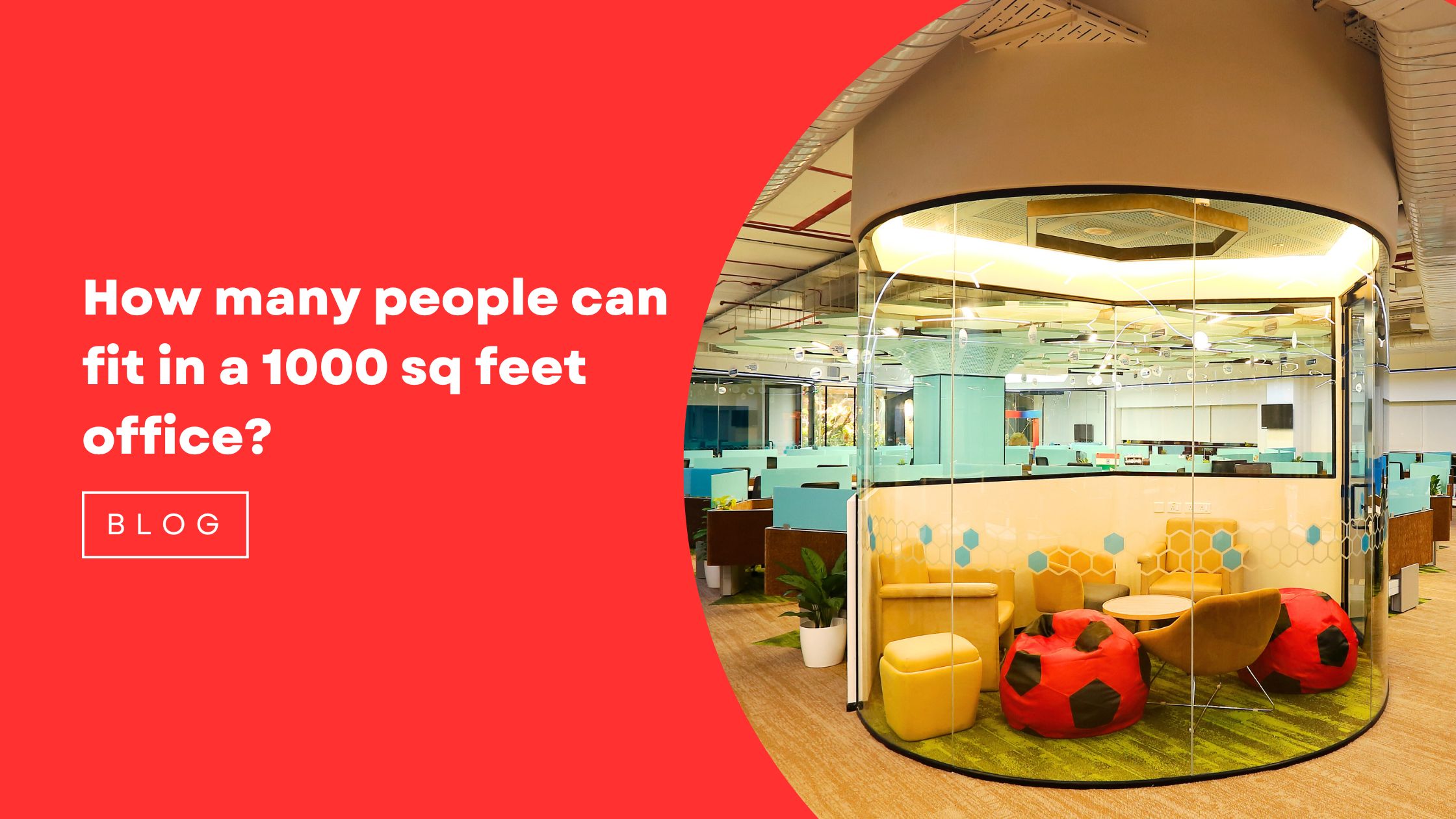
Finding the “perfect” number of people for a 1,000-square-foot office is a bit like asking how many toppings belong on a pizza—it depends entirely on who’s eating and how much room they need to breathe.
In the world of commercial real estate, 1,000 square feet is a “Goldilocks” size. It’s too big to be a closet but too small to be a corporate headquarters. It’s the sweet spot for startups, boutique agencies, and satellite teams. However, with the expertise of office interior designers, the difference between a productive workspace and a cramped “sweatshop” vibe comes down to utilization, layout, and culture.
Here is the definitive guide to maximizing your 1,000-square-foot footprint.
The Quick Answer: The Rule of Thumb
If you are looking for a fast estimate, the industry standard ranges from 100 to 150 square feet per person.
- High Density (The Startup Vibe): 75–100 sq. ft. per person (10–13 people)
- Average Density (The Modern Office): 125–150 sq. ft. per person (6–8 people)
- Spacious Density (The Executive Suite): 200+ sq. ft. per person (5 or fewer people)
But numbers on a spreadsheet don’t account for desks, coffee machines, or that one coworker who insists on having a standing desk and a walking treadmill.
1. The Math of Usable vs. Rentable Space
Before you start ordering desks, you need to understand the Efficiency Factor. In commercial leasing, there is a difference between Rentable Square Footage (RSF) and Usable Square Footage (USF). If your lease says 1,000 square feet, you might actually only have 850 square feet of “carpetable” space once you subtract the thickness of the walls and the shared building hallways.
The “Loss Factor”
Usually, you lose about 10–20% of your space to structural necessities.
- Net Space: ~850 sq. ft.
- Furniture & Circulation: ~250 sq. ft.
- Actual Work Area: ~600 sq. ft.
2. Defining Your Office Culture
How many people you can fit depends heavily on how those people work.
The “Open Plan” Enthusiasts (10–12 People)
If your team is comprised of Gen-Z creatives or a sales squad that thrives on high energy, you can lean into high density. By using long “bench” desks rather than individual cubicles, you eliminate wasted aisle space.
- Pros: Collaborative, cost-effective, high energy.
- Cons: High noise levels, zero privacy, “sensory overload.”
The “Quiet Professionals” (5–7 People)
Law firms, accounting practices, or coding shops often require deep focus. This usually means larger desks, acoustic dividers, or even private offices. In 1,000 square feet, you can typically fit three private offices and a small open area for support staff.
- Pros: Increased focus, professional aesthetic for client meetings.
- Cons: Lower headcount capacity, higher cost per employee.
3. The “Non-Desk” Space Requirements
People aren’t just robots sitting at stations; they need to eat, meet, and move. When planning a 1,000-square-foot layout, you must account for “The Essentials”:
| Feature | Average Space Needed |
| Small Conference Room | 150 sq. ft. |
| Kitchenette / Break Area | 100 sq. ft. |
| Reception / Waiting Area | 100 sq. ft. |
| Storage / Server Closet | 50 sq. ft. |
If you include all of the above, you’ve already used 400 square feet, leaving only 600 square feet for actual desks. In this scenario, you are looking at a comfortable capacity of 4 to 6 people.
4. Layout Strategies to Maximize Capacity
If you need to fit 10 people into 1,000 square feet without them quitting in protest, you have to be smart about the floor plan.
The Benchmarking Method
Instead of L-shaped desks, use straight desks (60 inches wide). Aligning them in rows (benchmarking) saves approximately 20-30% of floor space compared to traditional cubicles.
The “Hot Desking” Pivot
In the post-hybrid world, do you really need a desk for everyone? If you have 15 employees but only 8 come in at any given time, a 1,000-square-foot office is plenty. Implementing a desk-booking system allows you to “over-hire” for the space you have.
Go Vertical
Storage is the enemy of floor space. Use wall-mounted shelves and tall cabinets to keep the floor clear. The more floor you can see, the larger the office feels, which reduces the psychological feeling of being “crowded.”
5. The Psychology of Space: Why “Fitting” Isn’t Everything
There is a difference between physical capacity and psychological capacity. A study by the Journal of Environmental Psychology suggests that perceived crowding leads to higher stress levels and lower job satisfaction. If your 1,000-square-foot office is white-walled, windowless, and packed with 12 people, your turnover rate will likely be higher than your ROI on rent.
To make a small office feel big:
- Natural Light: Keep desks near windows.
- Glass Partitions: Use glass instead of drywall for meeting rooms to maintain sightlines.
- Common Colors: Neutral palettes with pops of color prevent the “closing in” feeling.
6. Safety and Legal Limits
Don’t forget the Fire Marshal. Every city has building codes that dictate the maximum occupancy for a space. This is usually based on the number of exits and the “egress” (the path to get out).
Typically, code allows for one person per 100-150 gross square feet, but you should always check your local zoning laws. If you pack 20 people into 1,000 square feet, you aren’t just being “frugal”—you’re likely violating safety ordinances.
Summary: The Final Verdict
So, how many people can fit in 1,000 square feet?
- The “Comfortable” Number: 6 People. This allows for a conference room, a break area, and decent-sized desks.
- The “Hustle” Number: 10 People. This requires an open-plan layout and minimal “extra” rooms.
- The “Hybrid” Number: 15+ People. This works only if you use hot-desking and never have everyone in the office at the same time.
Choosing the right number isn’t just about the square footage; it’s about the experience you want your team to have. Office interior designers understand that if employees spend all day fighting for elbow room, their productivity will drop far more than the money you’re saving on rent.
Frequently Asked Questions About 1,000 Sq. Ft. Office Space Planning
Q1: How many employees can comfortably fit into a 1,000 sq. ft. office?
A 1,000 sq. ft. office can comfortably accommodate between 8 to 14 employees, depending on whether you adopt an open-plan layout or include private cabins and conference rooms. Before finalizing your layout, it is important to estimate the right office size based on your headcount and workspace requirements.
Q2: What is the ideal square feet per employee ratio in modern office design?
Standard industry benchmarks recommend 75 to 100 sq. ft. per person for open-plan workspaces, and 120 to 150 sq. ft. per person for spacious hybrid or private cabin environments. These ratios should be considered alongside practical office layout principles to create an efficient and comfortable workspace.
Q3: How much area in a 1,000 sq. ft. office is used for common spaces?
Roughly 25% to 35% of total floor space is allocated to non-workstation areas, such as walkways/circulation paths, reception, small meeting rooms, server racks, and a coffee kiosk. Professional office space planning services can help determine the right balance between workstations, circulation and shared spaces.
Q4: How can open-plan layouts maximize seating in a small 1,000 sq. ft. office?
Utilizing benching workstations, wall-mounted storage, sliding glass doors, and shared collaborative tables maximizes usable floor area while maintaining comfortable traffic flow. The 3-5-7 rule for office interior design can also help maintain visual balance when planning a compact workspace.
Q5: What layout setup yields the highest employee capacity in 1,000 sq. ft.?
A linear open-plan workstation layout with minimal hard wall partitions allows maximum seating capacity (up to 12-15 desks) without violating ergonomic or safety guidelines. You can also explore compact office interior projects to see examples of how different workspace layouts are planned and executed.