
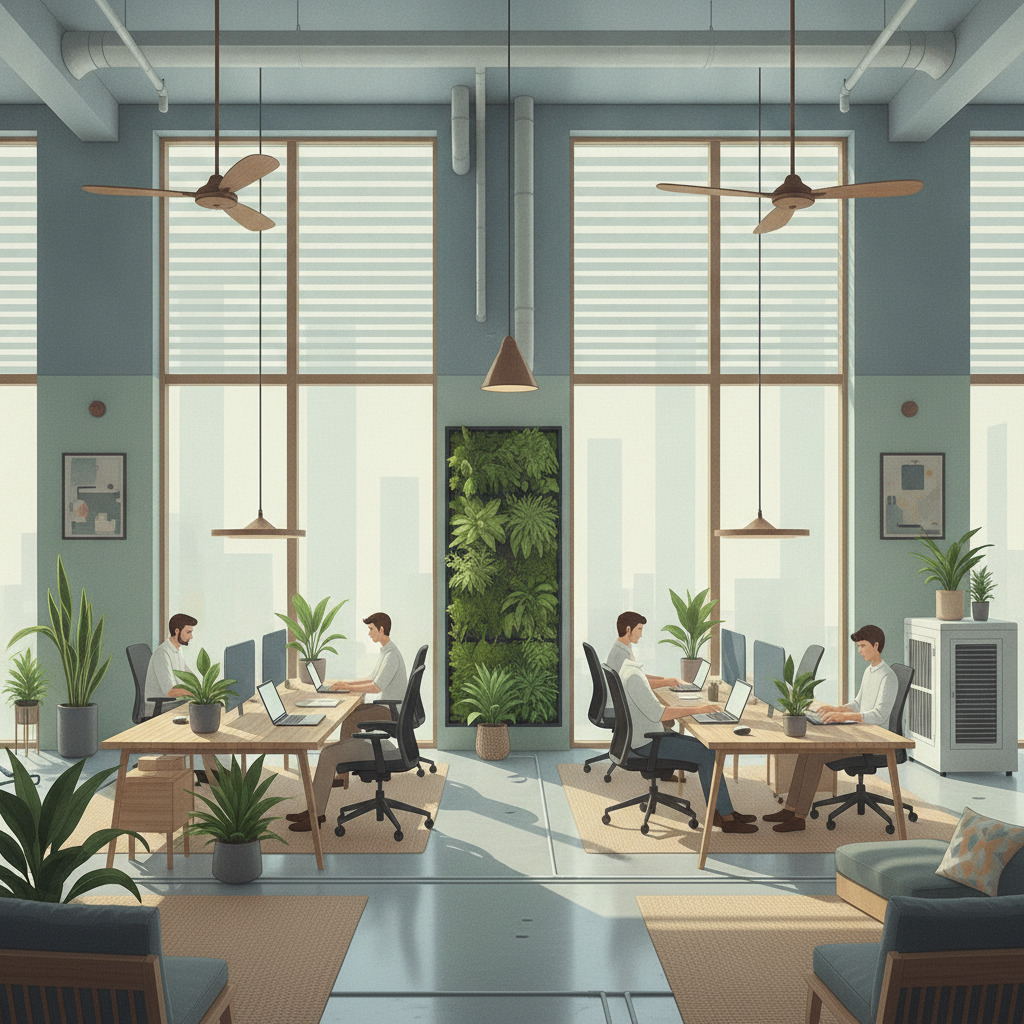
The Battle Against the Chennai Swelter
The oppressive heat of Tamil Nadu forces us to look at workplace architecture through a completely different lens. Adopting climate smart office design Chennai standards has shifted from a luxury to a basic requirement for survival. We still recall stepping onto the bare concrete floor of a high-rise project in Nungambakkam, where the heavy air felt almost thick enough to drink.
The massive glass facade functioned like a giant magnifying glass, trapping solar heat and leaving temporary cooling units to rattle and groan under the heavy load.
That afternoon made one thing clear. Standard layout practices brought over from cooler western climates simply fall flat in Tamil Nadu. Our journey on that project forced us to reshape our entire understanding of what a workspace should look like in a damp, tropical coastal zone.
This piece shares the exact, field-tested techniques we crafted to build comfortable, low-energy offices in intense environments.
By choosing climate smart office design Chennai organizations can shield their teams and slash running costs. We will break down the exact layouts, materials, and setups needed to hit this sweet spot. Readers will walk away with real-world ideas to construct workspaces that stand up to coastal extremes while keeping utility bills low.
The Core Philosophy of Climate Smart Office Design Chennai
Standard office layouts often treat the outdoor climate as an enemy to be locked out behind thick concrete and reflective glass. Years ago, we watched firms pour fortunes into giant cooling units, only to plague their staff with icy drafts, hot pockets, and stale, stuffy air. Real progress happens when we stop fighting the local weather patterns and start working alongside them.
We turned to regional building traditions, focusing heavily on natural breeze, soft daylight, and heat relief without draining the power grid. This change in perspective forms the core of green office design Chennai corporate clients now demand to meet carbon targets. We map sun paths, seasonal wind currents, and local humidity cycles before drawing a single line on our layouts.
The outcome of this early, thoughtful planning is a workplace that feels naturally balanced and welcoming. Staff members no longer have to bundle up in one zone only to sweat in the next. Our builds show that localized, weather-aware planning builds a far sturdier corporate setup.
Smart HVAC Setups in Corporate Interiors and Thermal Comfort
Cooling in a coastal city is far from a luxury. It acts as a vital lifeline for daily business operations. Standard cooling units often fall short because they only drop the temperature while ignoring the heavy moisture rolling off the Bay of Bengal.
Our engineering crew solved this by focusing on dedicated outdoor air setups that treat fresh air before it ever steps foot inside. This clever setup separates the cooling load from the moisture-stripping process. By pulling dampness out of the air first, the main cooling units can run at warmer, far more efficient settings.
This layout prevents that clammy, cold-office feel and stops moisture from pooling on the walls. We also put in smart sensors that shift airflow based on real-time headcount. Empty meeting rooms do not get the same icy blast as a crowded open workspace, saving up to thirty percent on power bills while keeping humidity at a comfortable fifty percent.
Comparative Analysis of Office Design Approaches
| Design Element | Traditional Office Design | Climate-Smart Office Design |
|---|---|---|
| HVAC Strategy | Basic cooling without moisture control | Fresh air systems that strip moisture first |
| Material Selection | Cheap fiberboard and paper walls that breed mold | Marine plywood, breathable silicate paints, and dense bamboo |
| Passive Design | Total dependence on big AC units and glass walls | Deep window recesses, outside shades, and heat-blocking glass |
Material Selection for Coastal Commercial Interiors
Thick humidity is the quiet destroyer of indoor finishes, warping solid wood, sagging drywall, and turning carpets into breeding grounds for mold. During a visit to an older office near the Chennai Port, we watched premium wood panels buckle from the salty air. That eye-opening moment pushed us to set up a strict materials guide built specifically for coastal commercial interiors.
We swapped out weak organic materials for tough, moisture-resistant alternatives. Dense bamboo, lime-based plaster, and marine-grade plywood became our go-to choices for walls and cabinets. These materials refuse to drink in moisture, keeping their shape and clean look for decades.
Choosing the right wall finishes is just as vital to stop mold from growing in quiet, dark corners. We choose low-chemical, silicate paints that let walls breathe instead of trapping dampness behind a plastic-like latex layer. The list below highlights the material swaps we suggest for these coastal zones.
- Opt for marine-grade plywood or dense bamboo instead of standard fiberboard.
- Use natural lime plaster or silicate paint instead of vinyl wall coverings.
- Lay down porcelain tiles or polished concrete instead of thick carpets in busy walkways.
- Select synthetic mesh or anti-mold fabrics instead of cotton upholstery.
Passive Cooling Methods for Resilient Chennai Workspaces
AC units should always play backup to smart, passive building layouts. At our build in Guindy, we used deep window recesses and external shades to block harsh sunlight before it ever hit the glass pane. This simple tweak cut the incoming heat by forty-two percent.
We also paid close attention to where we placed communal desks and individual seats. Busy team zones sat along the northern and eastern walls to catch soft morning light without the brutal afternoon glare. We pushed storage closets, restrooms, and server rooms to the south and west to absorb the brunt of the heat.
Double-pane windows with heat-blocking coatings are essential to combat the fierce Chennai sun. These special glass panes bounce away heat-carrying rays while letting natural light fill the room. Cutting down this heat transfer means we can install smaller, cheaper cooling systems.
- Face desks away from direct western windows to avoid the baking afternoon sun.
- Hang automated micro-mesh shades to block glare without losing the view.
- Add light-reflecting shelves to throw natural daylight deep into the middle of the floor.
- Put insulation on outside-facing interior walls to stop heat from bleeding through the concrete.
Biophilic Solutions for Humidity and Air Quality
Bringing nature inside is far more than a visual trend. It is a working tool to control the indoor air. We have installed living walls in several lobby areas to help clean the air and balance humidity.
These vertical gardens work as organic filters, soaking up toxins and keeping moisture steady. We pick specific plants that love warm, damp conditions and actively help clean the air. Boston ferns and peace lilies work wonderfully because they naturally absorb air pollutants and help stabilize indoor humidity levels.
Our team builds these setups with self-watering, closed-loop systems to prevent leaks and puddles. Proper drainage ensures that the plants do not raise the room’s humidity past comfortable levels. Seeing lush greenery combined with breathing cleaner air gives a massive lift to daily office morale.
- Use Boston ferns and peace lilies to naturally clean the air and help regulate indoor humidity.
- Set up self-contained green walls with proper drainage to stop standing water.
- Place plant beds near air vents to make the most of the natural filtering power of the leaves.
- Use soil-free growing mixes to avoid bugs and mold.
Acoustic Design and Airflow Dynamics in Coastal Spaces
High humidity can degrade standard acoustic materials, making noise control surprisingly tricky. When acoustic panels absorb water vapor, they lose their sound-absorbing efficiency and can harbor mold. We solved this puzzle near the Adyar River by using moisture-resistant acoustic panels wrapped in water-repelling fabric.
These special panels soak up noise without trapping dampness, avoiding that musty smell typical of old fiberglass ceiling tiles. We also added soft background sound systems that play gentle pink noise to mask distracting chats. This choice creates a peaceful workspace that pairs perfectly with a cool, airy aesthetic.
We must map air currents carefully to avoid dead spots where dampness can settle. Our team uses air-movement modeling to see how breezes flow through halls and meeting areas. This study helps us place vents in the best spots, ensuring constant fresh movement without creating cold drafts.
Lighting Methods to Mitigate Thermal Loads
Office lights produce a massive portion of indoor heat, which directly raises the temperature. Old bulbs and tube lights give off immense heat, making the AC struggle to keep up. Our focus on eco-friendly office design Chennai centers on using only low-energy LED systems.
These modern lights emit very little forward heat and use up to eighty percent less power than traditional fixtures. We pair these LEDs with sensors that dim the lights when the sun shines bright outside. This step cuts down the heat made by the bulbs themselves and slashes power usage.
The color of the light also affects how warm people feel. Cool white light between four thousand and five thousand Kelvin makes people feel cooler in hot climates. We use this visual trick in busy areas to make the environment feel crisp and refreshing.
The Financial Impact of Green Office Design Chennai
Many business leaders worry that climate-ready offices require massive upfront costs. We proved this wrong during a recent cost review of a sixty-thousand-square-foot building in Sholinganallur. Even though the initial cost for smart systems was twelve percent higher, the power savings paid back the difference in two years.
Lower power bills are only one part of the financial story. We also have to look at the sharp drop in sick days and the boost in daily output. A well-known study by the Harvard T.
H. Chan School of Public Health shows that staff in green-certified buildings with enhanced ventilation score significantly higher on cognitive tests.
By choosing long-lasting materials and smart setups, firms shield themselves from rising energy costs and early remodel bills. A tough, well-designed office stays open during extreme weather, keeping business running smoothly. Thoughtful building choices are not a cost, they are a solid asset that pays steady returns.
Key Takeaways for Resilient Workspaces
Creating a climate-ready workspace in Chennai demands a balanced blend of engineering and interior layout. Builders must step away from copy-paste blueprints and choose local solutions. Shifting to smart, green interiors is vital for long-term business success in coastal areas.
We gathered the best practices from our work to help you start your office upgrade. Focus on these main areas to build a high-performing, comfortable workspace.
- Put moisture control first in your cooling plans to keep humidity under fifty-five percent.
- Choose breathable, inorganic materials to stop mold and warping.
- Use outside shading and heat-blocking glass to stop solar heat before it enters.
- Install smart occupancy sensors to guide cooling where it is needed and cut waste.
These simple steps will change any office into a cool haven of work, even in the middle of the Chennai summer. Investing in tough setups protects both human comfort and the bottom line.