
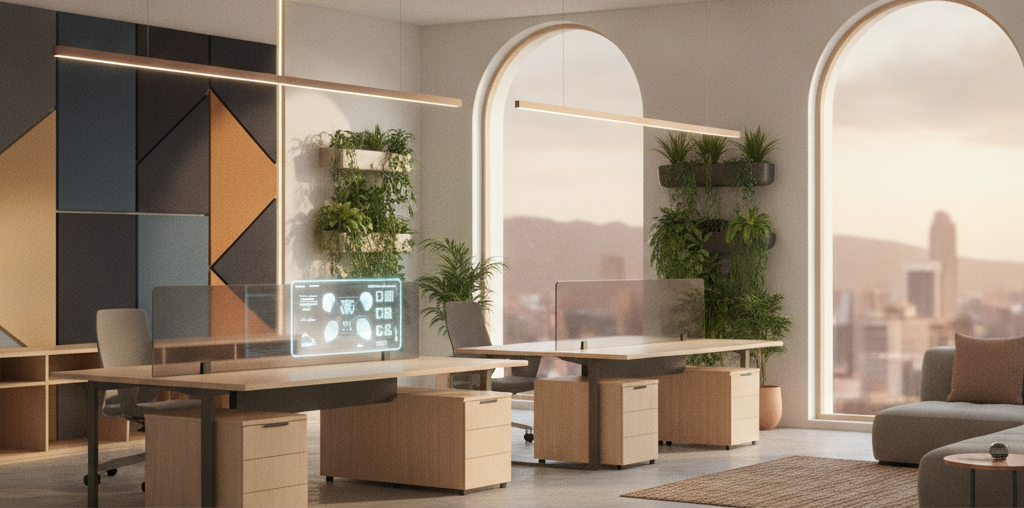
Workspaces have broken free from their old roles as mere holding pens for desks and computers.
Across the bustling technology corridors of Bengaluru and the expanding industrial hubs of Mysuru, the office has evolved. It is now a living, breathing ecosystem that tells a company’s story.
Observing modern office interior design trends in Karnataka has become vital for organizations rewriting the rules of corporate architecture in 2026.
This shift sparks a quiet revolution across the state. It reflects a deep commitment to employee well-being, regional identity, and environmental care.
By understanding these movements, business leaders can shape their commercial real estate into inspiring, high-performing hubs.
The Evolution of Office Interior Design Trends in Karnataka
Our journey into modern workspace design began years ago in the dense tech parks of Whitefield and Electronic City. Back then, corporations packed rows of identical cubicles under harsh fluorescent lighting.
The results were bleak. Teams felt disconnected, stuck in sterile environments that choked creative thought.
Today, the narrative has shifted. We now build human-focused spaces that celebrate local culture and flexible workflows.
Leaders recognize that physical spaces directly shape how people work and feel. The office interior design trends in Karnataka reflect a desire to balance tech demands with regional warmth.
This shift is obvious in how old corporate parks are being renewed. We recently stripped away the dark suspended ceilings of a thirty-thousand-square-foot facility in outer Bangalore. This let raw concrete breathe under natural light.
The change proved that modern workspaces must feel less like factories. They must feel like neighborhoods where people come together.
Biophilic Design in Karnataka Workspaces
Bringing the natural world indoors has grown from a design luxury into a basic necessity.
In our recent work, we drew inspiration from the lush canopy of the Western Ghats to create indoor microclimates. This matches the demand for green workspaces that local businesses proudly show to international guests.
We replaced artificial partition walls with vertical gardens of air-purifying plants. These living walls filter toxins and soften acoustics in open areas.
We selected native flora that thrives indoors with little water.
- Areca Palms: These plants act as natural humidifiers and scrub toxins from the air.
- Boston Ferns: These add lush texture and balance humidity in air-conditioned zones.
- Snake Plants: Hardy choices that need little care while releasing oxygen even at night.
Alongside greenery, the choice of raw materials has changed deeply. Designers now source Sadarahalli granite and locally reclaimed timber to reduce carbon footprint.
This sourcing supports local quarries. It gives the corporate environment an earthy grounding that matches the local landscape.
Modern Office Design Bangalore and Hybrid Layouts
The strict nine-to-five desk model has given way to fluid, flexible schedules.
To support this, organizations adopt hybrid layouts that welcome both remote and in-office staff. The focus is no longer on owning a desk, but on sharing specialized zones.
We worked with a software development firm in Indiranagar to restructure their floor plan.
We replaced eighty percent of assigned seating with hot desks, quiet pods, and open plazas. Employees now choose their spot based on the task at hand.
This dynamic setup is a key part of modern office design Bangalore companies use to welcome talent back. When employees brave city traffic, they expect a space that offers superior comfort and tools compared to their home setups.
The workplace must provide high-end video suites, ergonomic chairs, and lively social spaces to make the trip worthwhile.
- Acoustic Focus Pods: Solo cabins with double-glazed glass and sound-absorbing felt for deep concentration.
- Wooden Amphitheaters: Multi-tiered structures for spontaneous team huddles and town halls.
- Wellness Lounges: Quiet zones free of screens where employees can rest and recharge.
Weaving Cultural Heritage into Office Spaces
A successful workspace tells the story of its home and the community that sustains it.
In 2026, we see a beautiful convergence of tech and traditional craft. Bringing local heritage into the office is now a key regional design philosophy.
In our studio, we have led the way in bringing Channapatna wooden toys into corporate art installations. We worked with local artisans to scale up these traditional lacquered wooden shapes.
They became geometric divider screens and ceiling baffles. This brings lively, natural colors into the workspace while supporting rural craft communities.
The rich textile history of the region also shines in soft furnishings. We select hand-woven Mysore silk textures and local cotton fabrics for meeting room walls to soften the hard edges of glass and steel.
This mix of high-tech infrastructure and heritage craft creates a unique corporate identity that cannot be copied elsewhere.
Intelligent Workspaces and Smart Automation
Technology in 2026 is an invisible thread woven into the architecture. Sensors monitor occupancy, adjusting lighting, temperature, and ventilation automatically.
This automation helps manage operational costs and reach carbon neutrality. We set up smart lighting in a recent project that mimics the cycle of daylight.
The system starts with warm golden tones in the morning, shifts to crisp white light at midday, and softens in the late afternoon. This reduces eye strain and fits the biological rhythms of the workforce.
Booking systems connect directly with the physical space. Employees can reserve a desk through an app before leaving home.
Upon arrival, the desk adjusts to their preferred height and the screen welcomes them.
Ergonomic Excellence in Modern Workplaces
Designing for wellness goes far beyond placing a few plants in the lobby. During our talks with tech teams in Bangalore, we noticed frequent physical fatigue.
To address this, workspaces invest heavily in ergonomics as a core design principle. We set up height-adjustable desks across all zones as a standard choice rather than an optional luxury.
This allows employees to transition between sitting and standing throughout the day. It helps blood circulation and focus.
We paired these with task chairs that offer active lumbar support. Lighting design also plays a major role in physical comfort.
We replaced harsh overhead glare with task lighting that employees control individually. This minor change reduced eye strain among development teams.
Acoustic Solutions for Productive Environments
Open layouts are great for sharing ideas, but they present noise challenges. Distracting conversations and background hum often break concentration.
We solved this in a corporate office by putting up sound-absorbing ceiling clouds and wall panels made from recycled PET felt. These elements catch high-frequency sounds to prevent echoes.
We also introduced white noise machines that emit soft, natural soundscapes. Acoustic zoning is another strategy we use.
We separate loud gathering zones from quiet areas using corridors or green buffers. This spatial planning ensures different work styles exist without friction.
Applying Modern Workspace Approaches
Changing an existing corporate space into a modern environment requires a steady approach.
Business leaders do not need to overhaul everything overnight. Instead, a phased rollout allows for testing, feedback, and budget control.
We suggest starting with a utilization study to find underused zones. Often, large boardrooms sit empty all day, while tiny huddle rooms are booked solid.
Turning those large empty areas into small meeting spaces brings immediate benefits.
| Design Trend | Key Elements | Primary Benefit |
|---|---|---|
| Biophilic Design | Vertical gardens, native plants, Sadarahalli granite | Better air quality and stress relief |
| Hybrid Layouts | Hot desks, shared plazas, focus pods | Greater flexibility and talent retention |
| Cultural Integration | Channapatna toys, Mysore silk textures | Unique brand identity and artisan support |
| Smart Automation | IoT sensors, circadian lighting, app booking | Energy efficiency and smooth experiences |
This approach ensures that spending leads directly to happy employees and smooth operations.
By grounding decisions in feedback, organizations build spaces that stand the test of time.
- Run a spatial audit to track daily occupancy across different zones.
- Choose modular furniture that easily rearranges as the team grows.
- Spend on high-performance acoustic solutions to manage noise in open areas.
- Hire local artists to bring authentic regional identity into client zones.
Takeaways for Visionary Enterprises
The landscape of corporate design is changing across the region. To stay ahead, organizations must shift how they plan spaces.
Focusing on human needs, environmental care, and local heritage will define the best offices of the coming decade.
- Focus on adaptability so the workspace can adjust to shifting team sizes.
- Use nature and local materials to support health and meet green targets.
- Apply smart building systems to lower energy use and smooth out daily operations.
The future of corporate architecture in Bangalore and the wider Karnataka region lies in creating spaces that feel deeply human. They must be ecologically responsible and culturally rich.
By embracing flexible layouts, plants, and local heritage, organizations build a warm community rather than a mere office.
The office interior design trends in Karnataka show that when we design for people, productivity flows naturally.
Workspaces in 2026 will treat the office not as a dull expense, but as a lively tool for human potential.